Table of Contents
- What Makes Luxury Abstract Art with Diamonds Different
- Diamond-Encrusted Art: Evaluating Quality, Sparkle, and Durability
- Diamond Painting Kits vs. Original Diamond Art
- How to Choose Abstract Art for a Living Room
- Price, Provenance, and What You're Actually Paying For
- Care, Framing, and Installation
- Conclusion
- Frequently Asked Questions
Last Updated: October 5, 2026
What Makes Luxury Abstract Art with Diamonds Different
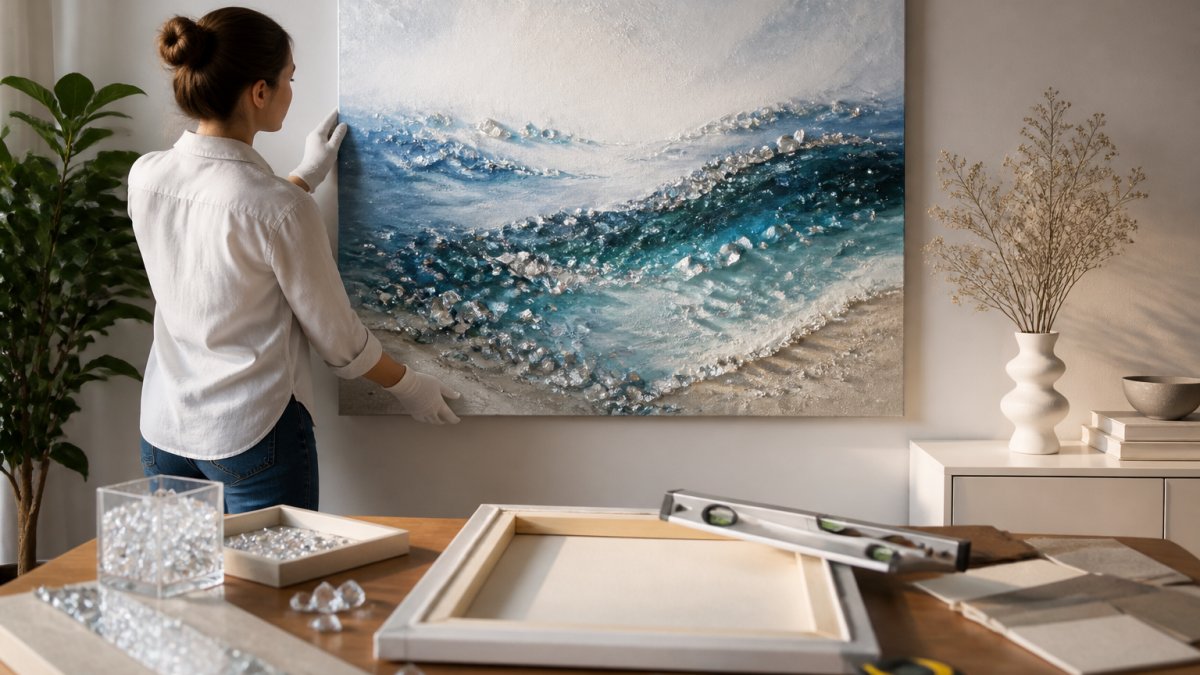
Luxury abstract art with diamonds is original artwork in which genuine gemstones are set directly into the painted surface, turning a canvas into both an image and an object.
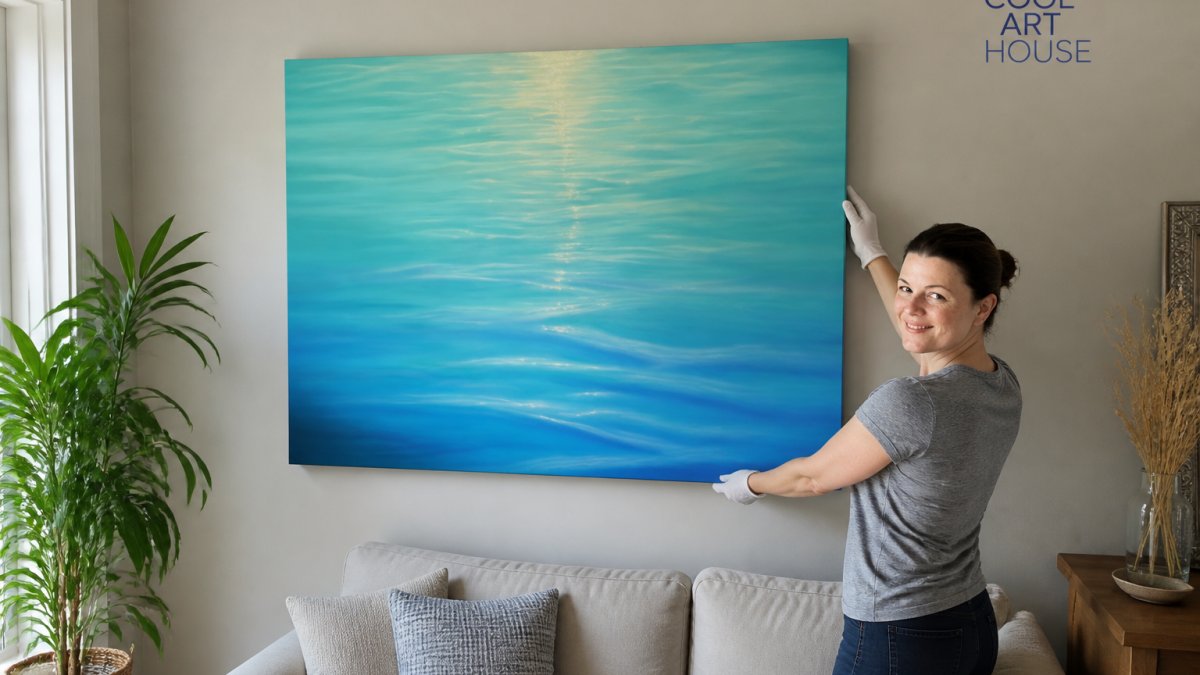
At Cool Art House, we offer print-on-demand stretched canvas prints of De Camille's original 'Ocean Bliss' seascape artwork. De Camille is a professional visual artist with over 30 years of experience and formal training in England, Paris, and California.
The role of genuine diamonds in fine art
Genuine diamonds function as a third layer of composition, sitting above the paint and below the viewer's eye. They scatter light in small, sharp points rather than broad washes, so artists place them deliberately: along a horizon line, inside a colour field, or at the centre of a gesture.
For a buyer, the artwork behaves differently at different times of day: cool white accents in morning light, amber tones under warm evening lamps.
How artists incorporate gems into canvas and panel
Application methods vary, and the method tells you a great deal about quality. Hand-set stones are placed individually into a prepared surface, often a build-up of iridescent and opalescent acrylics finished with textured oil paint, because the layers give each stone something to sit against.
Cheaper approaches press stones into a uniform, flat ground: even at first glance, but depthless, and prone to working loose.
A common mistake is judging a piece only from a photograph. Texture and layer depth are exactly what flat images hide best.
Diamond-Encrusted Art: Evaluating Quality, Sparkle, and Durability
Most listings mention "diamonds" and stop there, leaving buyers with no way to compare pieces. The framework below is what a jeweller would use, translated to a painted surface: judge the stones, the setting, the finish, and the documentation, in that order.
Reading the stones: the four Cs applied to art
Genuine diamonds are graded on cut, colour, clarity, and carat, but in artwork those grades matter differently than in a ring.
- Cut drives sparkle more than any other factor: a well-cut stone returns light, a poorly cut one leaks it, and cut quality is what makes a stone "pop" from arm's length.
- Colour is usually near-colourless in fine art, because tinted stones fight the paint palette. Slight warmth can be intentional in gold-dominant pieces, but visibly mixed colours signal unmatched stones.
- Clarity matters less than in jewellery because stones are small and viewed at distance; what matters is that no stone has an obvious dark inclusion visible to the naked eye.
Setting methods and what they signal
There are three broad approaches, each telling you something about the maker.
- Hand-set into a prepared surface. The artist builds up layers, often iridescent and opalescent acrylics finished with textured oil, then seats each stone individually. Slowest, most dimensional, with stones at slightly varied depths that catch light unevenly.
- Channel or recessed setting. Stones sit in a carved line or groove. Clean and graphic, but less forgiving: if one stone is lost, the gap is obvious.
- Pressed into a flat ground. The cheapest approach: even in photographs, flat in person, and most likely to work loose because no layered substrate holds the stones.
Ask which method was used. A maker who cannot answer is usually working with the third.
Sparkle: why the same piece looks different in every room
Sparkle is not a property of the stone alone but a relationship between the stone, the paint beneath it, and the light in the room.
Durability: what actually causes stones to fail
Stones come loose for predictable, almost always preventable reasons.
- Adhesive failure. If the bond between stone and surface breaks down, the stone lifts. Sealed surfaces resist this; unsealed ones do not.
- Thermal cycling. Repeated expansion and contraction, a canvas above a radiator, or in a room with wide temperature swings, stresses the bond over years.
- Humidity. Prolonged moisture softens many adhesives and can cloud a finish.
A properly finished piece, kept out of humidity and direct heat, should hold its stones for decades. The best durability question to ask a seller is whether the surface is sealed and what was used.
Documentation: the paper trail that separates real from marketing
- Stones: matched in size and colour, no visible dark inclusions, total carat weight stated
- Setting: hand-set into a layered surface, stones flush or slightly proud, none spinning
- Sparkle: visible variation in how stones catch light as you move past the piece
Diamond Painting Kits vs. Original Diamond Art
Diamond painting kits and original diamond art are two different products that share a name. Cool Art House offers prints of De Camille's original 'Ocean Bliss' seascape artwork.
Neither is better in the abstract. They serve different buyers.
| Feature | Diamond Painting Kits | Original Diamond Art |
|---|---|---|
| Stones | Resin or foil drills | Genuine diamonds |
| Canvas | Pre-printed adhesive grid | HD canvas, hand-painted |
| Who makes it | You, following a chart | A trained artist |
| Skill built | Fine motor skills, hand-eye coordination | Not applicable |
| Best for | Beginners, hobbyists, gifts | Collectors, interior designers |
| Resale value | Minimal | Depends on the artist |
Kits have real value: they are meditative, build fine motor skills and hand-eye coordination, and cost a fraction of a finished artwork.
If you want the object, buy the artwork. The two are not substitutes, and treating a kit as an investment is a mistake.
How to Choose Abstract Art for a Living Room
Choosing abstract art for a living room comes down to three variables: scale, colour, and placement. Get the scale right and almost anything works. Get it wrong and even a beautiful piece looks like an afterthought.
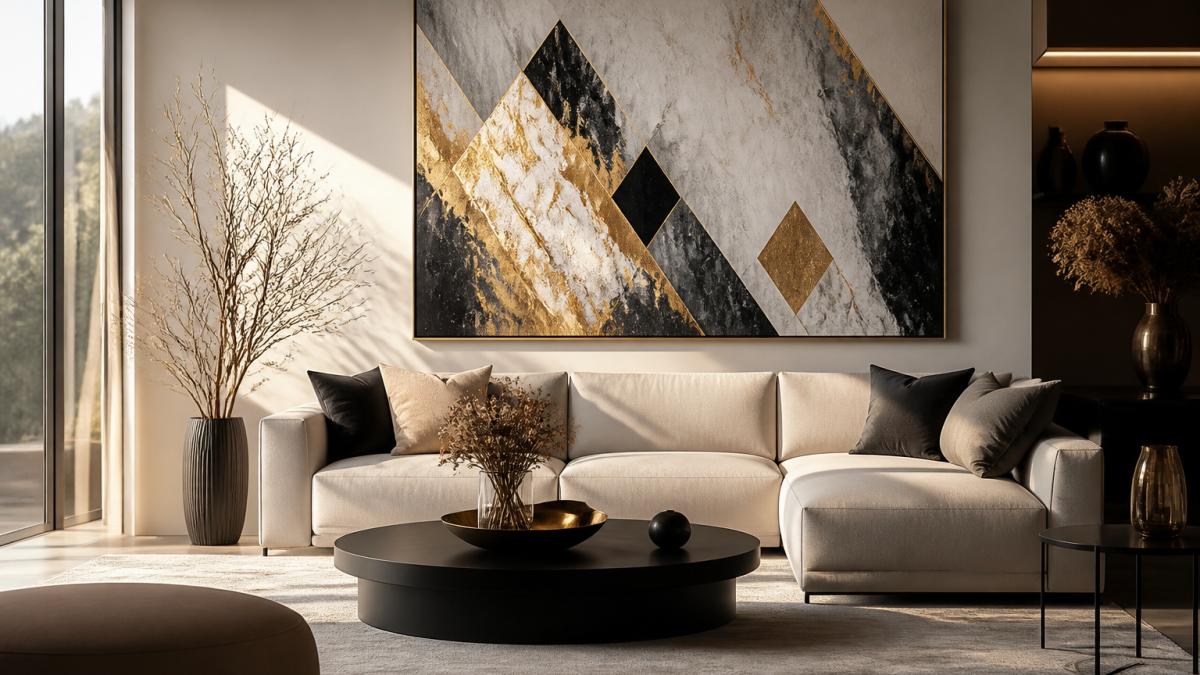
Scale, color, and placement by room
Scale first. Artwork should span roughly two-thirds to three-quarters of the width of the furniture below it, above a standard sofa, usually around 40 x 40 inches or a multi-panel set covering similar width.
Colour second. Gold, black, and neutral palettes suit most living rooms because they read as calm rather than loud; a golden painting with black accents adds warmth without competing with your furniture.
Placement third.
- Living room: large-scale statement piece or multi-panel set
- Bedroom: softer palette, smaller scale, lower contrast
- Home office: one bold piece behind the desk for focus
Price, Provenance, and What You're Actually Paying For
Price in this category is the sum of four inputs, materials, artist time, provenance, and size, and knowing which one drives a given price is the difference between a considered purchase and an expensive mistake. Most guides skip this, which is why buyers routinely overpay for materials and underpay for authorship.
The four cost drivers, and how they interact
Materials. Genuine diamonds, layered acrylics, textured oils, and a properly stretched HD canvas all carry real cost, and the stones alone set a floor on any large piece.
Provenance. The most overlooked driver and the one that most affects long-term value.
Size. Larger canvases cost more to make, ship, and frame, and shipping scales non-linearly: a piece over a certain dimension may require crating, adding substantially to delivered cost.
How to assess value without a price list
Because pricing varies by size, format, and availability, the useful skill is not memorising numbers but reading the relationship between price and the four drivers.
- A high price with strong provenance and genuine stones is defensible; with no artist history and vague material claims, it is not.
- A low price on a large piece with claimed genuine diamonds usually means the stones are not what they are described as.
- A mid price on a smaller piece with excellent provenance can be better value than a large, anonymous canvas.
The single most useful question to ask is: what am I paying for here, the materials, the artist, or the size? A seller who can answer that clearly is usually selling something real.
Verifying originality and artist credentials
Originality is the claim most often made and least often checked. Three steps close the gap.
- Ask for the artist's name and look them up independently. A working artist will have a traceable presence, exhibitions, gallery representation, press, or a documented body of work. A name that returns nothing is a red flag.
- Ask whether the piece is an original painting or a print. Stretched canvas prints are legitimate products, but not the same object as a hand-painted piece with set stones. The distinction should be stated before purchase, not discovered on delivery.
- Ask for a certificate of authenticity or an appraisal. Not every artist issues one, but the willingness to provide documentation is itself a signal.
Many collectors weight provenance more heavily than materials, because materials are replaceable and authorship is not: a well-documented piece by a trained artist holds its identity.
The investment question, answered honestly
"Investment-worthy" is a claim about the artist, not the object. Resale markets for living artists are thin and uneven, and most pieces in this category will not appreciate predictably. Buy because you want to live with the piece, and treat any appreciation as a bonus, never a plan.
What provenance buys you is optionality: a documented artist is easier to resell, insure, and pass on than an anonymous canvas, even if neither is guaranteed to gain value.
- Materials: layered paint, properly stretched canvas (for the original artwork), sets the price floor
- Artist time: De Camille's hand-painting and hand-setting (for the original artwork), multiplied across panels
- Provenance: training, exhibitions, collections, the only driver that can appreciate
Care, Framing, and Installation
Humidity is the quiet enemy. Keep the piece out of bathrooms and away from radiators, and avoid direct, sustained sunlight, which fades pigments over years.
Framing is optional for stretched canvas, and many buyers prefer the clean edge of a gallery wrap.
For installation, two hooks rather than one keep a wide canvas level, and a spirit level saves a second round of holes.
- Dust monthly with a soft dry brush
- Keep away from radiators, bathrooms, and direct sun
- Frame with clearance if framing at all
Conclusion
Choosing luxury abstract art is a decision about how a room should feel, not just how it should look. The hard part is finding work where the artist's background holds up to scrutiny.
At Cool Art House, we offer stretched canvas prints of De Camille's original 'Ocean Bliss' seascape artwork, backed by more than 30 years of experience, formal training in England, Paris, and California, and a 30-day money back guarantee with worldwide shipping.
Get started with Cool Art House and bring a meditative, striking centrepiece into your home.
Frequently Asked Questions
What is the difference between diamond-encrusted art and diamond painting?
Diamond-encrusted art features genuine diamonds or gemstones set into the surface of an original painting, often alongside gold foil, textured oils, or iridescent acrylics. Cool Art House offers prints of De Camille's original 'Ocean Bliss' seascape artwork. Diamond painting is a craft kit where you place small resin 'diamonds' onto a sticky canvas to form a picture. The first is a collectible fine art piece; the second is a meditative hobby. They serve completely different purposes and price points.
How do I know the diamonds in a piece are real?
Legitimate artists provide documentation such as a certificate of authenticity that states the carat weight and source of the stones. Ask for this before buying. Reputable sellers welcome questions about materials and provenance.
Can I put diamond-encrusted artwork in a living room with strong sunlight?
Yes, but prolonged direct sunlight can fade the pigments in any print over time. Hang the piece on a wall that receives indirect or diffused light. If you want a dramatic focal point, use a picture light with a low-heat LED bulb. Rotate the artwork occasionally to limit exposure to one side.
How should I clean and maintain a diamond-encrusted painting?
Dust gently with a soft, dry microfibre cloth. Never use water, glass cleaner, or abrasive pads because moisture can dull the print. For deeper cleaning, use a can of compressed air held at a distance to blow dust out of the crevices. If the piece is framed under glass, clean only the glass with a standard non-ammonia cleaner sprayed onto the cloth, not the artwork.

Leave a comment
This site is protected by hCaptcha and the hCaptcha Privacy Policy and Terms of Service apply.