Table of Contents
- Best Abstract Art for Modern Homes: Styles and Formats
- Abstract Art for Living Room Walls
- Large Abstract Canvas Art: Scale, Impact, and Placement
- How to Choose Abstract Wall Art for Your Home
- Abstract Art Trends 2026: What Collectors Are Buying
- Bedroom and Entryway Abstract Art Ideas
- Budget, Materials, and Value: What to Know Before You Buy
- Frequently Asked Questions
Last Updated: October 4, 2026
Best Abstract Art for Modern Homes: Styles and Formats
Choosing the best abstract art for modern homes starts with what each format delivers and where it will hang. This Cool Art House guide covers styles, sizing, placement, and budget.
Abstract wall art gives a room a focal point without dictating a literal story.
The market reflects that demand. According to Statista's art market outlook, abstract and contemporary works continue to hold a strong share of online art sales as more buyers shop for original pieces digitally.
Below, we break down the best abstract art for modern homes by style, format, room, and budget, with a sizing framework you can apply the moment you measure your wall.
Canvas, framed, and mixed media: what each format delivers
Canvas prints and original canvas art dominate modern homes because they hang without glass and read as one continuous surface.
Framed wall art adds a border: a thin black or natural wood frame sharpens a geometric piece, while a floating frame gives a canvas a gallery look.
| Format | Best For | Trade-Off |
|---|---|---|
| Stretched canvas | Large-scale art, open walls | Needs dusting, no glass protection |
| Framed canvas | Gallery look, defined edges | Adds cost and visual weight |
| Framed print | Budget walls, quick swaps | Less texture, flatter surface |
| Mixed media | Focal points, collectors | Higher price, delicate surface |
For most modern living rooms, a stretched or framed canvas is the practical default: it suits large-scale art, hangs easily, and does not glare under a window the way glass does.
Abstract Art for Living Room Walls
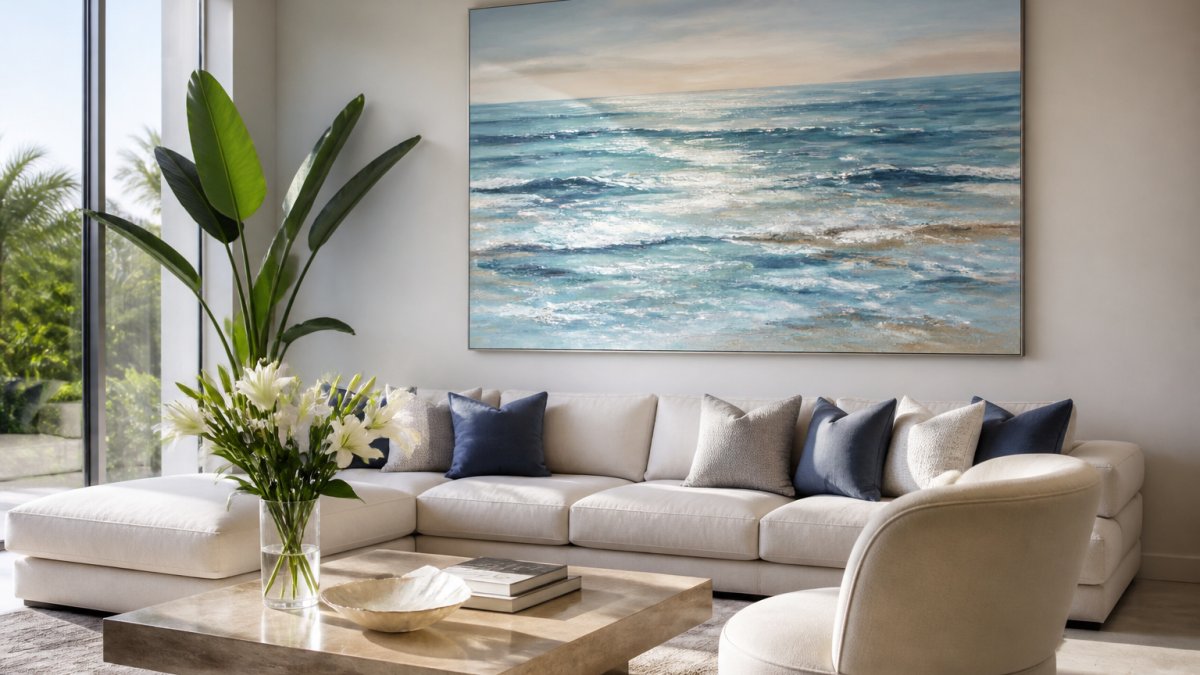
The living room is where abstract art for living room walls earns its keep, the largest wall, the most seating, the most eyes.
A common mistake is buying art that is too small, a small canvas on a large wall looks like a stamp on an envelope.
Sizing by wall dimensions and viewing distance
Art placement starts with two numbers: wall dimensions and viewing distance, how far the main seat sits from the wall, which decides how much detail the eye can absorb.
A simple rule: for every metre of viewing distance, allow roughly 20 to 25 centimetres of art height. A sofa three metres from the wall supports a piece about 60 to 75 centimetres tall.
Large Abstract Canvas Art: Scale, Impact, and Placement
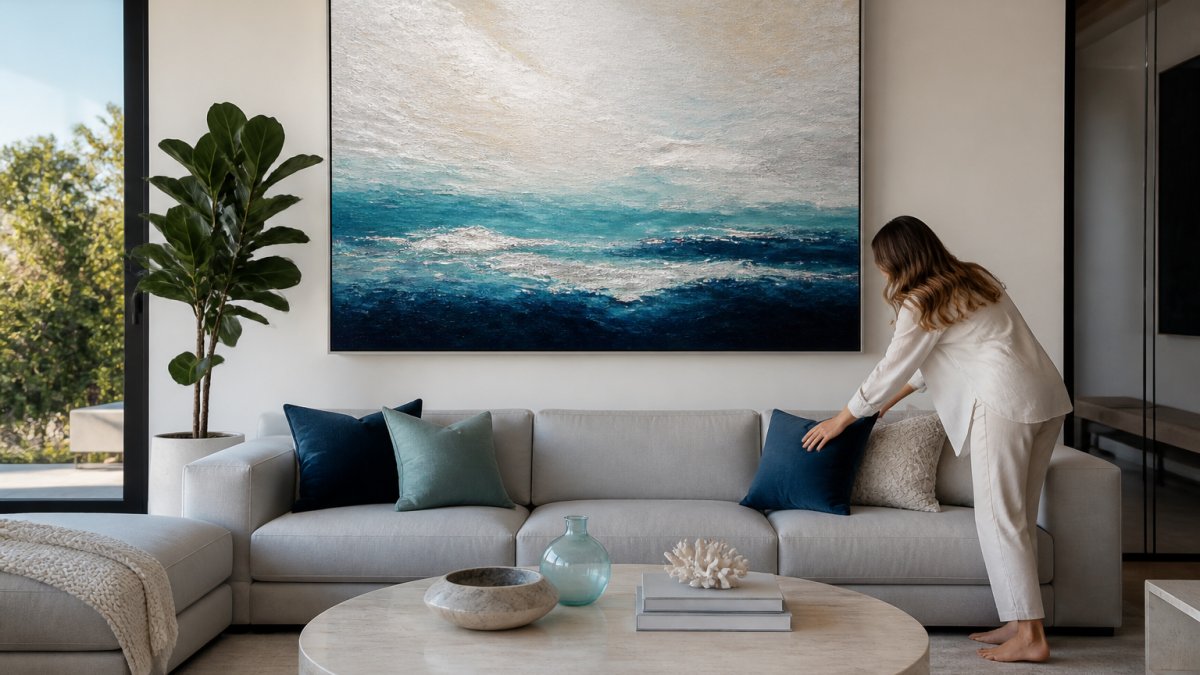
Large abstract canvas art is the fastest way to give a modern room a focal point.
Scale is about proportion to the space and the weight of the composition. A bold multicolor piece on a neutral wall pulls the room together; a soft monochrome piece on a busy wall can disappear.
Placement matters just as much. Oversized canvas belongs on the wall you face when you enter, or above the main seating. Avoid all-day direct sunlight, since UV light fades pigments.
- Keep at least 20 to 30 centimetres between the art and the top of the sofa
- Leave 5 to 10 centimetres of breathing room on each side of a framed piece
- Centre art on the furniture, not the wall, when the two differ
How to Choose Abstract Wall Art for Your Home
Knowing how to choose abstract wall art comes down to three checks: color, scale, and feeling. Run them in order and most decisions make themselves.
Start with color. Pull one or two colors from the room, a cushion, a rug, a wood finish, and let the art echo them.
Then check scale against your wall and viewing distance using the sizing rule above.
Coordinating art with furniture, finishes, and color palettes
Coordination is where most buyers second-guess themselves, and it is easier than it looks. Treat the art as the final layer, not the starting point.
- Warm wood and brass: choose warm neutrals, ochre, or soft rust
- Cool greys and chrome: cool blues, greys, and crisp white work best
- Black and white interiors: a single bold color becomes the accent
Texture is the quiet coordinator. Visible brushwork or a layered surface ties together a room of smooth, flat finishes by adding the one thing modern interiors often lack: depth.
Abstract Art Trends 2026: What Collectors Are Buying
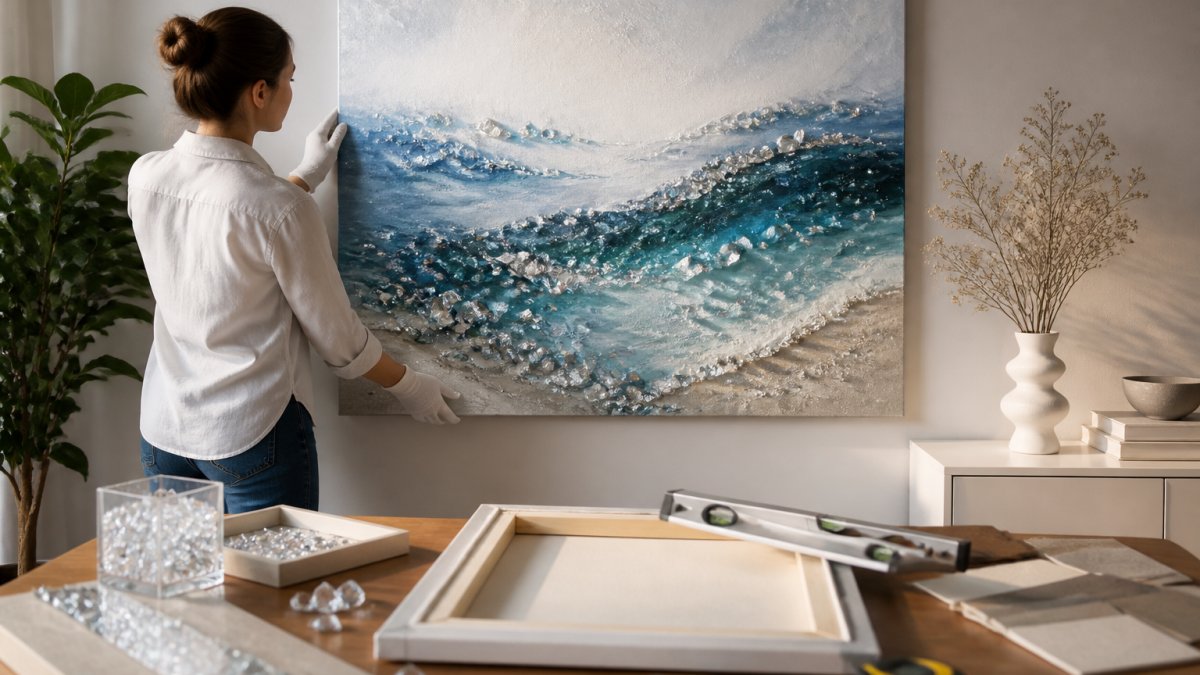
Abstract art trends 2026 point toward calm, depth, and tactility over loud statement prints, as buyers move from flat, mass-produced designs toward pieces with real surface and presence.
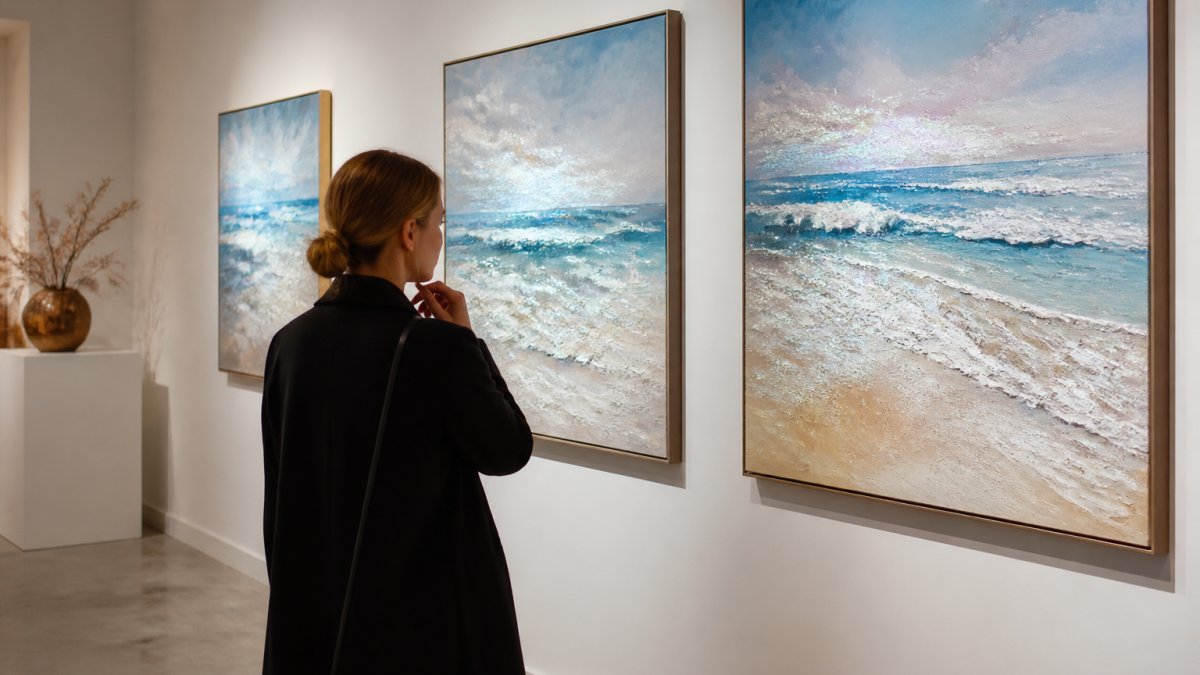
Nature-inspired art holds strong, especially seascapes and landscape-inspired abstracts that bring stillness indoors.
The bigger shift is material. Collectors now care how a piece is made, not just how it looks in a thumbnail.
Bedroom and Entryway Abstract Art Ideas
Bedrooms and entryways call for different energy than a living room, and different numbers. Bedroom decor wants calm; entryway decor wants a confident first impression. The piece that delivers either depends on wall width, ceiling height, and how close you stand, so here is a room-by-room framework you can apply with a tape measure.
Bedroom: scale to the bed, not the wall
The bed is the anchor, so size the art to the headboard or the wall opposite the foot of the bed, not to the full wall width.
- Above the headboard: aim for art that spans roughly two-thirds the width of the bed. A queen bed is about 1.5 metres wide, so a piece around 1 to 1.1 metres across sits comfortably. Leave 60 to 70 centimetres of clearance between the top of the headboard and the bottom of the frame so the art does not crowd the sleeper.
- Opposite the foot of the bed: this is the first thing you see on waking, so it can carry more size. A piece 90 to 120 centimetres wide works on a standard bedroom wall, centred on the bed rather than the wall.
- Viewing distance: from the pillow to the opposite wall is often 3 to 4 metres. At that distance, a piece 60 to 90 centimetres tall reads clearly without dominating. Soft neutrals, gentle blues and greens, and seascape or floral abstracts rest the eye; high-contrast geometrics tend to activate it, which is the opposite of what a bedroom needs.
Entryway: work with the corridor, not against it
An entryway is a small stage you pass in two seconds, so the rules flip. Width is usually limited, but height is available.
- Narrow hall (under 1.2 metres wide): choose a vertical canvas. A piece 50 to 70 centimetres wide and 90 to 120 centimetres tall uses the height and keeps the corridor from feeling blocked.
- Wide foyer (1.5 metres or more): a horizontal piece or a tight pair works. Keep 5 to 10 centimetres between paired frames so they read as one unit.
- Hanging height: because you view entryway art standing and moving, centre it slightly higher than living-room art, around 150 to 160 centimetres from the floor.
Home office: structure for focus
A home office sits between the two. Geometric or nature-inspired abstracts in a cool palette support concentration, and the art should sit in your peripheral vision rather than directly behind your monitor, where it competes for attention. If you take video calls, hang the piece on the wall behind the camera so it frames you without glare.
- Bedroom: two-thirds the bed width, 60-70 cm clearance above the headboard, soft palette
- Entryway: vertical format in narrow halls, 150-160 cm centre height, high contrast
- Home office: geometric or nature-inspired, cool palette, off-axis from your sightline
Budget, Materials, and Value: What to Know Before You Buy
Budget and value come down to three variables: format, materials, and provenance. Here is the framework that helps you decide what to spend and where the money goes.
Format and value: what you are really paying for
| Format | Typical price band | What drives cost | Longevity |
|---|---|---|---|
| Open-edition print | Lowest | Printing, paper, shipping | Fades near windows; replaceable |
| Limited-edition print | Mid | Edition size, paper quality, signature | Holds up with archival inks and paper |
| Stretched canvas print | Mid | Canvas, frame, print method | Good if archival; dusts easily |
| Original painting | Highest | Artist time, materials, uniqueness | Appreciates with the artist's career |
| Mixed media / textured original | Highest | Layered materials, drying time, fragility | Distinctive but needs careful handling |
Buyers regret going too small far more often than spending a little more. Scale is the biggest driver of visual impact, and a large print usually beats a small original on a big wall.
Materials: what affects how a piece ages
- Pigments: archival or lightfast pigments resist fading; cheap dye-based inks can dull within a few years in bright rooms.
- Substrate: cotton or poly-cotton canvas holds paint and print better than thin synthetic fabric. Paper prints need UV-filtering glass or acrylic to survive near windows.
- Surface: textured acrylics and oils change with the light through the day; flat prints stay static. Texture is often what separates a piece from a poster in person.
Provenance: the value that does not show in a thumbnail
Original and handcrafted work carries the artist's hand, which holds character over time. When buying online, protect yourself with this checklist before you commit:
- Confirm the artist's background and training
- Ask whether the work is original, limited edition, or open edition
- Request the edition size if it is a print
Where value hides
Value is not the lowest price, it is the piece you still want on the wall in five years. Three places it hides:
- Scale for the money. A large archival print often delivers more room impact per dollar than a small original.
- Materials that last. Archival pigments and quality canvas cost more up front and less over time, because you are not replacing a faded piece in three years.
- A named artist. Work with a clear artist behind it holds interest and, in some cases, resale value that anonymous mass-produced prints do not.
Cool Art House addresses these concerns directly. Every piece is created by professional visual artist De Camille, who brings over 30 years of experience and formal training in England, Paris, and California.
For guidance on caring for and displaying fine art, the American Institute for Conservation publishes practical advice on light, humidity, and handling that applies to any canvas you bring home.
Frequently Asked Questions
What size abstract art should I choose for my living room?
For a sofa wall, aim for a canvas that spans 60 to 75 percent of the furniture width. Above a three-seat sofa, that usually means a piece 120 cm to 180 cm wide. Leave 15 cm to 30 cm between the art and the sofa back. Large abstract canvas art works best when its center sits at eye level, roughly 145 cm to 155 cm from the floor.
How do I choose abstract wall art that matches my existing decor?
Pull one or two colors from your room's existing palette and look for art that repeats them. If your furniture is neutral, a bold multicolor piece becomes the focal point. If your room already has strong patterns, choose a monochrome or neutral palette piece. Texture matters too: iridescent and mixed media surfaces catch light and add depth that flat prints cannot.
What are the abstract art trends for 2026?
Nature-inspired and seascape abstracts continue to lead, especially pieces with layered texture and iridescent finishes. Collectors are moving toward handcrafted original artwork over mass-produced prints, and toward oversized canvas formats for open-plan rooms. Neutral palettes with one vivid accent remain popular, as do geometric art pieces softened with organic brushwork.
Where should abstract art be placed in a modern home?
The living room is the primary spot, usually above the sofa. In bedrooms, hang a calming piece opposite the bed so it is the first thing you see. Entryways suit a vertical or square canvas at eye level. Avoid direct sunlight on original artwork, and add a picture light or adjustable spotlight to bring out texture and iridescent layers.

Leave a comment
This site is protected by hCaptcha and the hCaptcha Privacy Policy and Terms of Service apply.